

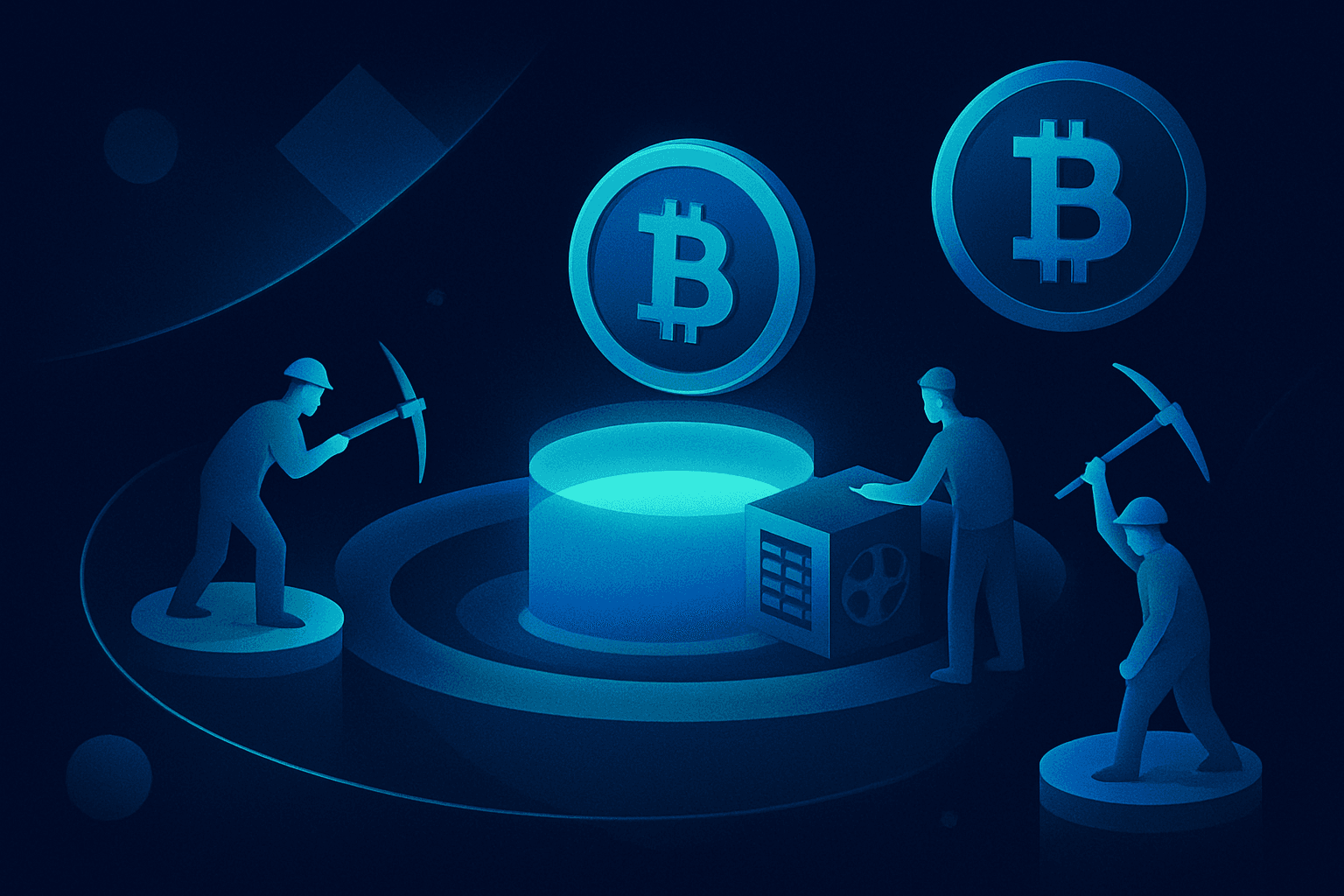
If you searched what is bitcoin mining pool after seeing headlines about SBI Crypto’s planned shutdown, the important point is simple: a mining pool is a coordination service for miners, not Bitcoin itself.
Reports this week suggest SBI Crypto plans to shut down a Bitcoin mining pool that holds roughly 2% of Bitcoin’s hashrate. That sounds technical, but the reader’s real question is practical: does this weaken Bitcoin, disrupt transactions, or change how mining works?
We often see students move from confusion to confidence, and mining is one of the topics where jargon creates more fear than clarity. So let’s slow it down: what a pool is, why Bitcoin hashrate matters, and what typically happens when a pool operator turns off the lights.
What is Bitcoin mining pool, in plain English?
A Bitcoin mining pool is a group arrangement where many miners combine their computing power and share any rewards the pool earns. Each miner still owns or operates their own mining machines, but the pool coordinates the work and distributes payouts according to each miner’s contribution.
Mining is competitive. Roughly speaking, miners run specialized computers that repeatedly guess numbers in a global race to find the next valid Bitcoin block. A block is a batch of transactions added to Bitcoin’s public ledger, called the blockchain.
For a small miner, solo mining can mean long stretches with no reward at all. A pool smooths that uncertainty. Instead of hoping one miner finds a block alone, the group competes together and splits the proceeds when the pool succeeds.
This distinction matters. A mining pool can shut down, change fees, or lose participants, but Bitcoin does not rely on any single pool to exist. Bitcoin’s base rules are run by the network’s nodes and miners together, not by one company.
For a broader introduction to Bitcoin’s role in money and settlement, start with our Bitcoin & Sound Money pillar guide. If you want the bigger monetary backdrop, our guide to why Bitcoin moves with gold and silver can help connect mining security to the wider market narrative.
How Bitcoin mining works without the heavy math
To understand a pool shutdown, you only need the basic flow of how bitcoin mining works.
Miners collect valid transactions, package them into a candidate block, and try to produce a proof of work. Proof of work means the miner must show real computational effort before the network accepts the block.
That effort is costly because miners use electricity and specialized hardware. Bitcoin uses this cost as part of its security model: rewriting history would require an attacker to outcompete honest miners across the network.
Here is the simple version:
- 1Miners point machines at a pool — their hardware sends computing work toward the pool’s chosen block template.
- 2The pool tracks contributions — it measures how much work each miner provides.
- 3The pool submits valid blocks — if the pool finds a valid block, it broadcasts it to the Bitcoin network.
- 4Rewards are shared — the pool distributes payouts based on its rules, fees, and each miner’s contribution.
In day-to-day use, you do not need to join a mining pool to send or receive Bitcoin. When we walk students through their first wallet setup, the most common mistake is assuming every Bitcoin user must understand mining operations before they can use the network. They do not. But knowing the basics helps you interpret headlines calmly.
A mining pool is like a team entering a lottery where the number of tickets depends on computing power. The team does not change the rules of the lottery. It simply gives participants a more regular share of outcomes.
Why Bitcoin hashrate matters for network security
Bitcoin hashrate is the total amount of computing power miners are directing at Bitcoin. More precisely, it reflects how many hash attempts miners are making per second to find valid blocks.
A hash is a one-way calculation: easy to verify, impractical to reverse. Miners perform massive numbers of these calculations as they compete for blocks.
Hashrate matters because it is one signal of Bitcoin network security. The more honest computing power is protecting the chain, the harder it becomes for an attacker to overpower the network and reorganize recent transaction history.
Hashrate is not the only thing that matters. The distribution of that hashrate matters too. If too much mining power is coordinated through too few pools, the network becomes more dependent on a smaller set of operational chokepoints.
Bitcoin also adjusts its mining difficulty over time. Difficulty is the network setting that keeps blocks from arriving too quickly or too slowly over the long run. If hashrate falls for a sustained period, difficulty can adjust downward; if hashrate rises, difficulty can adjust upward.
That adjustment is one reason Bitcoin is resilient. It does not require a fixed set of miners, countries, companies, or pools. It responds to changes in total mining power according to its rules.
What SBI Crypto’s pool shutdown does and does not mean
According to recent industry coverage, SBI Crypto plans to shut down a Bitcoin mining pool with roughly 2% of Bitcoin’s hashrate. That is meaningful enough to notice, but it is not automatically a crisis for Bitcoin.
The key question is whether the miners connected to that pool stop mining entirely or simply redirect their machines to other pools. In many pool shutdowns or migrations, miners have economic incentives to keep their hardware running if mining remains viable for them.
Think of it like a freight company closing one dispatch office. The trucks do not necessarily vanish. Many drivers may sign up with another dispatcher the same day or week.
The same principle applies here. A pool operator can exit, but the underlying mining machines may continue contributing to Bitcoin hashrate somewhere else.
What can change when a pool exits
A shutdown can create short-term movement in pool rankings. Other pools may gain share as miners redirect equipment. Payout schedules can change for individual miners, especially if they switch to a pool with different fees or reward rules.
There can also be operational friction. Miners may need to update configuration settings, test connectivity, and choose a new pool they trust. For large mining businesses, this is normal infrastructure management rather than a philosophical event.
What usually does not change for everyday users
For ordinary Bitcoin users, a pool shutdown usually does not change how wallets work. You can still send and receive Bitcoin. Nodes still validate blocks according to Bitcoin’s rules.
Transactions may feel unaffected unless the shutdown contributes to a broader, sustained drop in total hashrate or creates unusual congestion. A single pool exit, especially one where miners migrate, is mainly a mining-industry event.
For more on separating market noise from network fundamentals, see our guide to what moves crypto prices and our explainer on Bitcoin derivatives and panic headlines.
Pool shutdown versus hashrate loss: the difference matters
The phrase “pool holds 2% of Bitcoin’s hashrate” can be misleading if read too quickly. It does not necessarily mean one company owns 2% of all mining machines. It means the pool has been coordinating that share of mining work.
That distinction is central to a calm reading of the headline.
| Event | What it means | Why it matters |
|---|---|---|
| Pool shuts down | A coordination service stops operating | Miners need a new pool or setup |
| Hashrate migrates | Machines keep mining through another pool | Bitcoin security may be largely unchanged |
| Hashrate disappears | Machines stop mining Bitcoin | Total network work may fall until conditions adjust |
| Pool concentration rises | Fewer pools coordinate more work | Decentralization becomes a bigger discussion |
The healthiest outcome is not simply “more hashrate at any cost.” It is robust hashrate spread across many independent operators and jurisdictions, with miners able to move when a pool changes terms or shuts down.
Better way to read the headline
- Ask whether miners are migrating or leaving.
- Watch pool concentration, not just total hashrate.
- Separate Bitcoin’s protocol rules from mining-business decisions.
Common mistake to avoid
- Assuming a pool shutdown means Bitcoin itself is shutting down.
- Treating coordinated hashrate as company-owned hashrate.
- Confusing short-term mining movement with permanent security loss.
This is also why decentralization is not a slogan. It is a practical property. When participants can leave one service and continue elsewhere, the network becomes harder to capture.
Why miners use pools instead of mining alone
Solo mining is still possible, but it is often impractical for smaller participants because rewards are unpredictable. A miner could contribute work for a long time and never find a block on their own.
Pools trade jackpot-style uncertainty for steadier income. Miners generally accept pool fees in exchange for predictable reward distribution, infrastructure, monitoring, and support.
Different pools can use different payout methods. Some emphasize lower variance, meaning smoother income. Others may pass more variance to miners but use different fee structures. Beginners do not need to memorize every model; they only need to understand that pool rules affect miner payouts, not Bitcoin’s core supply rules.
This is similar to how exchanges or wallet apps create user experiences around crypto without changing the underlying protocol. If you are still building the basic mental model, our plain-English CryptoWhat how-it-works library is a good next stop.
What pool concentration means for Bitcoin network security
Bitcoin network security is strongest when no single actor can easily control block production. Mining pools complicate that picture because many independent miners may appear under one pool’s name on public dashboards.
A pool operator can influence which transactions it includes in the blocks it coordinates. But miners are not permanently trapped. If a pool behaves badly, censors transactions, changes economics unfairly, or becomes unreliable, miners can redirect their machines.
That exit option is powerful. It does not make concentration irrelevant, but it makes pool share different from ownership share.
Still, concentration deserves attention. If a small number of pools coordinate too much hashrate, the network depends more heavily on miners’ willingness and ability to leave those pools if needed. This is why educators, developers, and miners often discuss better pool design, better monitoring, and more geographic and operational diversity.
The practical takeaway: Bitcoin’s security is not only about total computing power. It is also about how easily that power can move.
What everyday Bitcoin users should watch after a pool exits
Most users do not need to monitor mining pools daily. But if a high-profile pool shuts down, a few signals can help you understand what is happening without overreacting.
First, look for whether total Bitcoin hashrate changes materially over time or whether the pool’s share simply appears under other pools. Short-term noise is normal.
Second, pay attention to whether blocks continue arriving and transactions continue confirming. Bitcoin is designed for changing mining conditions, but users should always understand that confirmation times can vary.
Third, watch the decentralization conversation. If miners redistribute across several pools, that can be healthier than all of them moving to one already-dominant pool.
Finally, avoid turning one infrastructure headline into a price prediction. Mining, macro conditions, derivatives, exchange flows, and investor sentiment can all affect markets differently. If your question is price behavior rather than network mechanics, our article on what Bitcoin below major price levels can mean explains why context matters more than one number.
FAQ: Bitcoin mining pools and shutdowns
What is a Bitcoin mining pool?
A Bitcoin mining pool is a group of miners who combine computing power and share rewards when the pool finds a block. It helps miners receive more predictable payouts than solo mining.
Does a mining pool shutdown make Bitcoin less secure?
A mining pool shutdown only weakens Bitcoin security if hashrate actually leaves the network instead of moving to other pools. If miners redirect their machines, the effect may be mostly organizational.
What is Bitcoin hashrate in simple terms?
Bitcoin hashrate is the total computing effort miners are using to secure the Bitcoin network. Higher honest hashrate generally makes attacks more difficult.
Can one mining pool control Bitcoin?
One pool cannot change Bitcoin’s rules by itself, but high pool concentration can create coordination risk. Miners can reduce that risk by moving away from pools that become too dominant or behave poorly.
Do I need to join a mining pool to use Bitcoin?
No, you do not need to join a mining pool to use Bitcoin. Most people interact with Bitcoin through wallets, exchanges, or nodes, while miners handle block production.
Conclusion: what is Bitcoin mining pool teaches us about resilience
The SBI Crypto shutdown headline is useful because it reveals how Bitcoin actually works. A pool is a coordinator, hashrate is the work securing the network, and a shutdown matters most when it changes where miners point their machines—or whether they keep mining at all.
The calm takeaway is not “ignore mining headlines.” It is to read them correctly. Bitcoin is resilient because participants can move, nodes can verify, and no single pool is the network.
If you want a structured path from basics to confidence, take CryptoWhat’s free courses and start with the foundations in our guided learning signup.
CryptoWhat does not provide financial, investment, or trading advice. All content is for educational purposes only.